Duration: 36 months
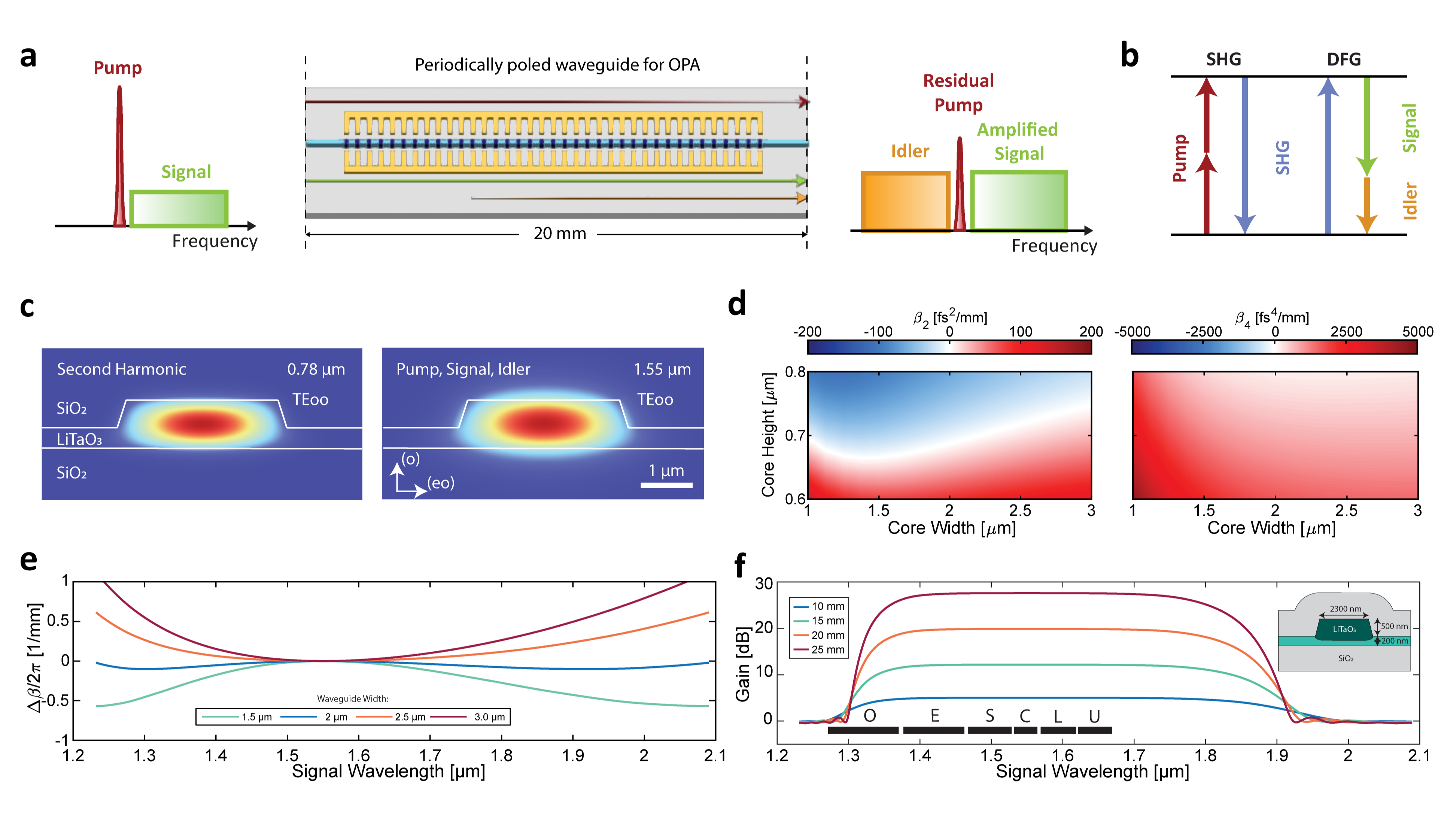
Optical amplifiers are cornerstone components for optical systems for both ground and space amplification allowing to amplify broadband transmission for optical communication, metrology, and spectroscopy, as well as to amplify to weak receive signals above the thermal noise floor of optical detectors. The ideal optical amplifier would be compact, electrically pumped, highly efficient, ultra-broadband, and operate unidirectionally with high saturation power. The mechanism that can simultaneously fulfill all these requirements is a traveling-wave optical parametric amplifier (TWOPA) that use the intrinsic material nonlinearities of transparent media to amplify weak signals and generate a phase conjugate idler [1], [2].
This project focuses on developing photonic integrated circuits using thin-film ferroelectric materials like lithium niobate (LN) and lithium tantalate (LT) [3] to create ultra-broadband nonlinear optical amplifiers and quantum light sources.
We aim to overcome limitations of current technologies by exploring new nanofabrication methods and hybrid laser integration, enabling applications in optical communication, quantum light sources, and spectroscopy. The strong second-order nonlinearity (χ(2)) and excellent damage threshold and optical birefringence and dispersion characteristics of LN and LT opens up the possibility to convert, amplify, and process a wide bandwidth of optical frequencies for classical applications such as optical amplification and quantum applications such as optical squeezing and entanglement at sufficiently low powers to facilitate direct integration of the nonlinear waveguide with III-V optical gain elements as pump laser source to achieve the required size, weight, power and cost (SWaP-C) for applications in space and on-board small satellites.
[1] J. Hansryd and P. A. Andrekson, “Broad-band continuous-wave-pumped fiber optical parametric amplifier with 49-dB gain and wavelength-conversion efficiency,” IEEE Photonics Technology Letters, vol. 13, no. 3, pp. 194–196, Mar. 2001, doi: 10.1109/68.914318.
[2] J. Riemensberger, N. Kuznetsov, J. Liu, J. He, R. N. Wang, and T. J. Kippenberg, “A photonic integrated continuous-travelling-wave parametric amplifier,” Nature, vol. 612, no. 7938, pp. 56–61, Dec. 2022, doi: 10.1038/s41586-022-05329-1.
[3] C. Wang et al., “Lithium tantalate photonic integrated circuits for volume manufacturing,” Nature, pp. 1–7, May 2024, doi: 10.1038/s41586-024-07369-1.
[4] N. Kuznetsov et al., “An ultra-broadband photonic-chip-based traveling-wave parametric amplifier,” Apr. 12, 2024, arXiv: arXiv:2404.08609. doi: 10.48550/arXiv.2404.08609.
[5] J. Zhang et al., “Integrated Triply Resonant Electro-Optic Frequency Comb in Lithium Tantalate,” Jun. 27, 2024, arXiv: arXiv:2406.19368. doi: 10.48550/arXiv.2406.19368.
[6] C. Wang et al., “Integrated lithium niobate electro-optic modulators operating at CMOS-compatible voltages,” Nature, vol. 562, no. 7725, Art. no. 7725, Oct. 2018, doi: 10.1038/s41586-018-0551-y.
[7] Z. Li et al., “High density lithium niobate photonic integrated circuits,” Nat Commun, vol. 14, no. 1, Art. no. 1, Aug. 2023, doi: 10.1038/s41467-023-40502-8.
[8] P.-K. Chen, I. Briggs, C. Cui, L. Zhang, M. Shah, and L. Fan, “Adapted poling to break the nonlinear efficiency limit in nanophotonic lithium niobate waveguides,” Nat. Nanotechnol., vol. 19, no. 1, pp. 44–50, Jan. 2024, doi: 10.1038/s41565-023-01525-w.