Duration: 36 months
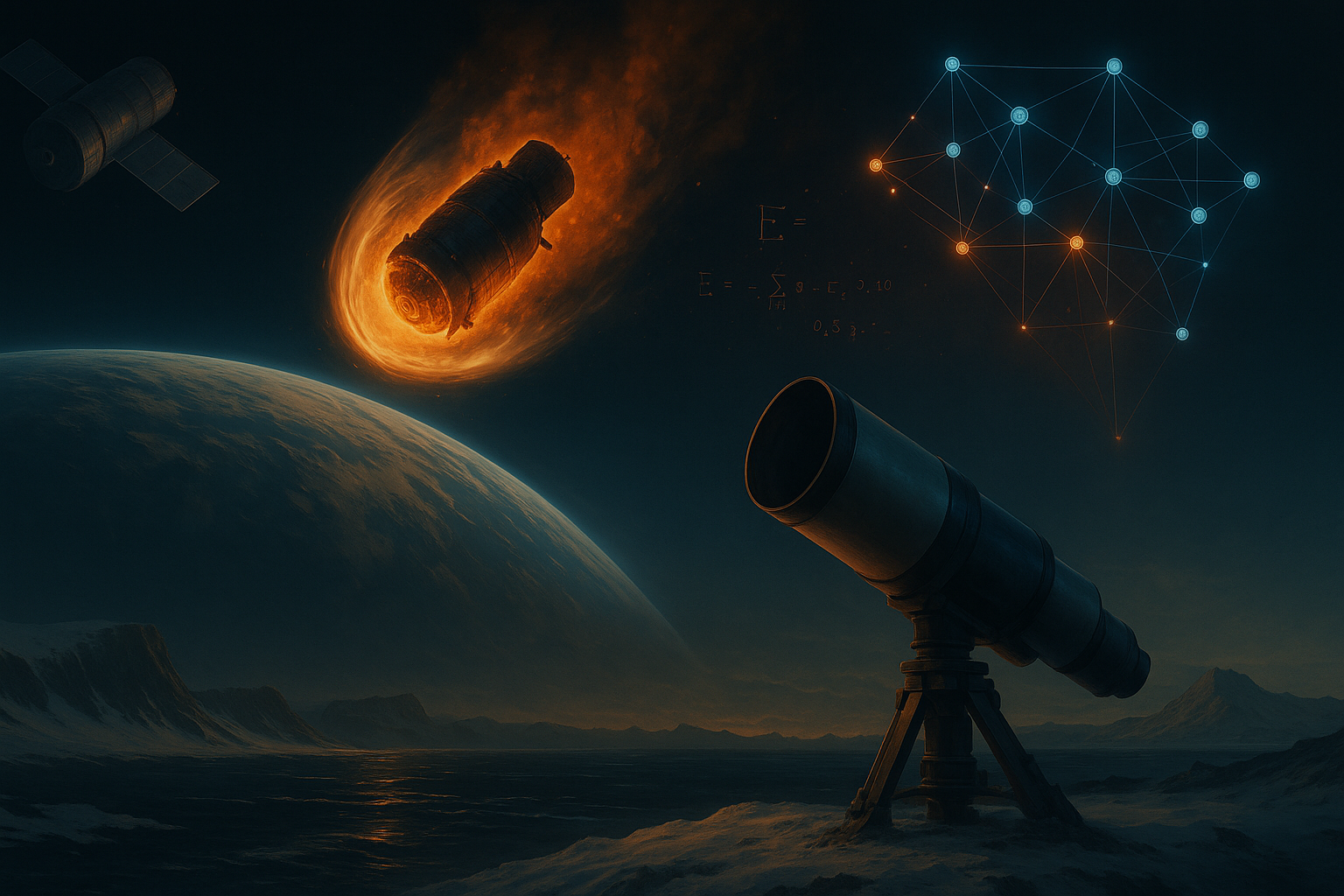
The design-for-demise strategy is being challenged by concerns about atmospheric pollution, exacerbated by satellite mega-constellations. Accurately modelling re-entry physics (material ablation and mass deposition in the atmosphere) traditionally relies on computational fluid dynamics (CFD) calculations that can be prohibitively expensive. Machine learning (ML) surrogate models offer a promising alternative by emulating high-fidelity CFD results with significantly reduced computational overhead, thereby enabling rapid yet accurate predictions of debris behaviour and potential environmental impact.
The proposed framework focuses on developing ML-driven surrogate models that, coupled with trajectory simulations, could capture key phenomena such as gas-surface interactions and the release of ablated materials into the atmosphere. A comprehensive validation campaign is planned, combining dedicated plasma wind tunnel tests (e.g., VKI Plasmatron) with observational data from DTU’s telescopes based in Greenland and Denmark, which observe actual re-entry events. This collaboration leverages complementary expertise from the Université Libre de Bruxelles, ULB (re-entry aero-thermodynamics), the Vrije Universiteit Brussel, VUB (ML surrogate modelling), and the Technical University of Denmark, DTU (optical observations and trajectory modelling), ensuring robust model verification and applicability across diverse re-entry scenarios.
By integrating these surrogate models into established ESA tools, including DRAMA, this approach aligns with the European Space Agency’s ongoing initiatives in debris mitigation and sustainability. It also supports the Zero Debris Charter’s objective of minimising the environmental footprint of space activities through faster, more efficient re-entry predictions. This combined focus on advanced computational methods and experimental validation seeks to strengthen space safety strategies and promote responsible stewardship of near-Earth orbits.