Duration: 26 months
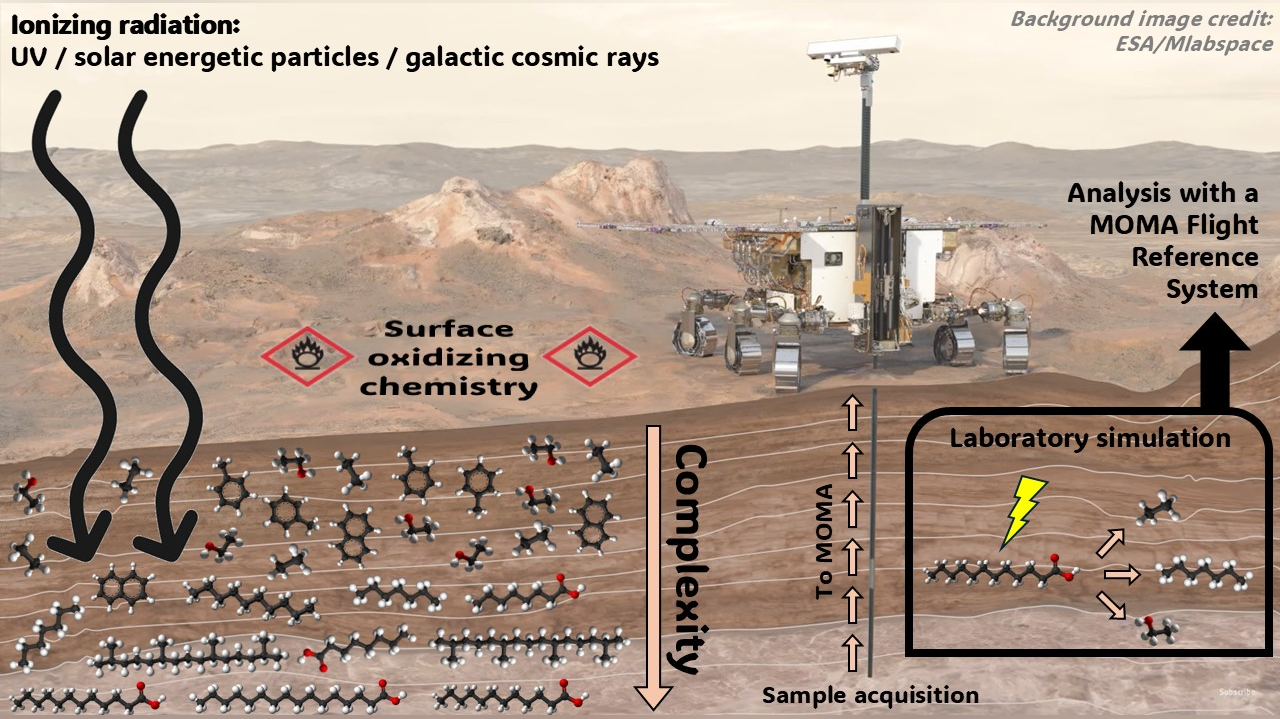
The Mars Organic Molecule Analyser (MOMA) onboard the Rosalind Franklin rover is designed to analyze and detect organic molecules in Martian samples collected from depths between 0 and 200 cm. This unprecedented drilling capacity is key to mitigate the effects of radiation and regolith oxidants. MOMA’s objective, however, faces an obstacle: constant exposure of the target organics to radiation over billion-year timescales. Radiation is one of the most pervasive and destructive agents in the extraterrestrial environment, capable of degrading complex organic molecules into simpler forms, regardless of the encapsulating matrix.
Underscoring the need for robust biomarkers in the search for life, membrane lipids emerge as promising targets due to their elevated geostability relative to other biomolecules. Their hydrocarbon skeletons are known for resilience against thermal and diagenetic alteration, yet their biologically significant functional groups – such as oxygen-bearing moieties – are inherently labile. Understanding how these features degrade under the effects of cosmic radiation is crucial for determining whether a seemingly abiotically-generated pool of organics on Mars may have once had a biological foundation.
We propose to leverage MOMA’s detection capabilities using the Flight Reference System (FRS), a ground-based replica of the instrument to analyze for the first time lipid stability and fragmentation patterns under simulated cosmic radiation. By examining degradation pathways of lipid-like structures, we aim to refine the understanding of lipid taphonomy and reconstruct potential parent molecules of higher complexity. Our findings will provide tools for the accurate interpretation of MOMA data before the rover reaches Mars, ensuring effective analysis can be performed within ESA’s proprietary data period. This would eventually facilitate timely publication before ingestion into the Planetary Science Archive.