Duration: 12 months
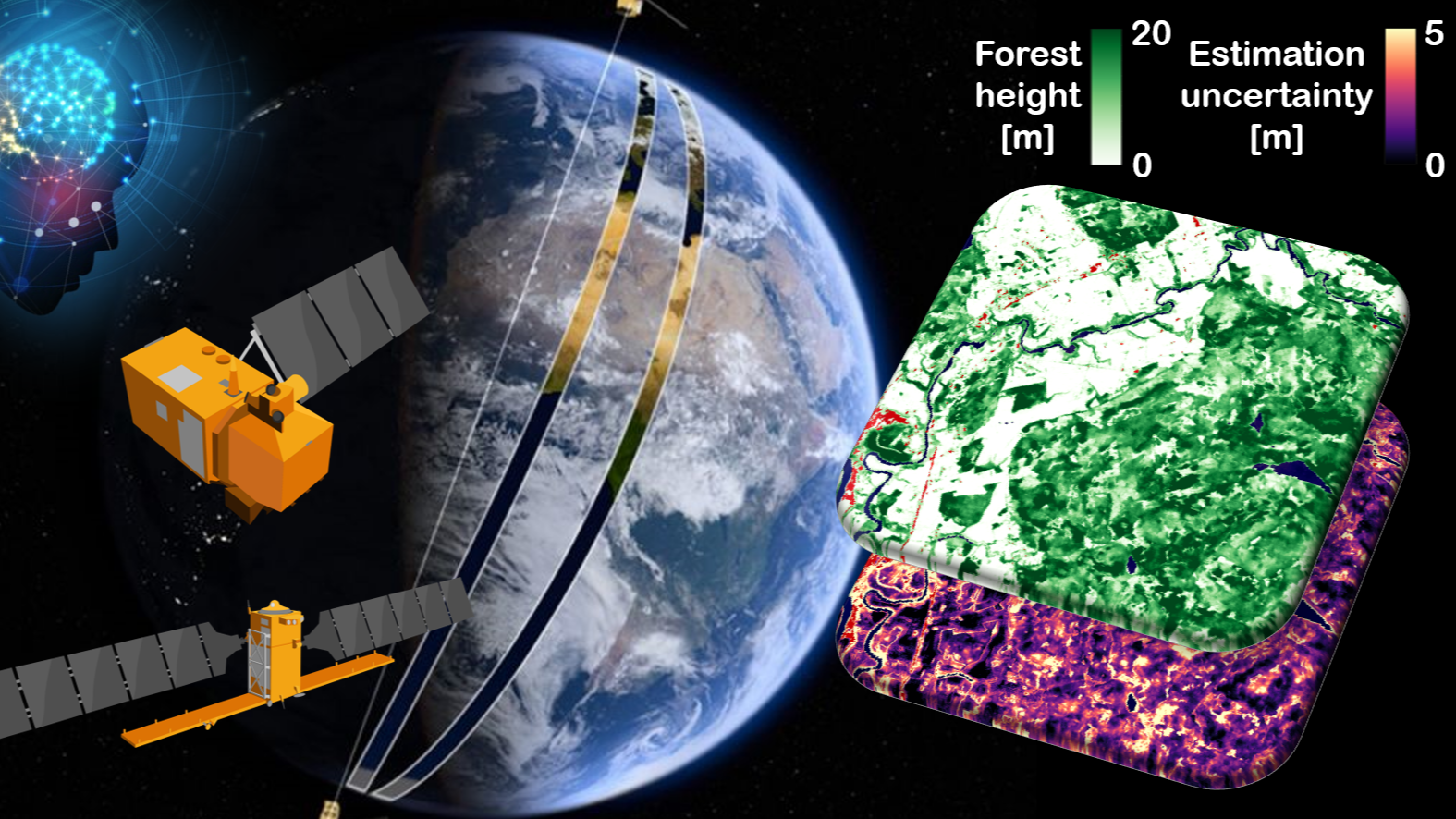
Monitoring biophysical parameters greatly benefits from spaceborne remote sensing; however, its full potential remains underexploited due to the limitations of traditional theoretical models in capturing large-scale biophysical variability. The proposed idea tackles the challenges of using deep learning (DL) in Earth Observation (EO) for the regression of biophysical parameters in presence of a limited amount of high-quality reference data and for the estimation of the prediction uncertainty, which is crucial for change monitoring purposes. The core objective is to explore and benchmark innovative self-supervised learning (SSL) strategies to design effective pretext tasks that enable meaningful knowledge transfer to downstream regression tasks. While SSL methods, especially masked autoencoders (MAE), have shown promise in semantic segmentation, their adaptation for regression tasks in EO is still in its early stages and requires deeper investigation. As a case study, we will focus on the regression of forest biophysical parameters, such as canopy height, by relying on Sentinel-1 and Sentinel-2 data, integrating optical, repeat-pass InSAR, and dual-polarization SAR information. For the SSL pretext tasks, we will develop and compare physics-aware domain alignment techniques across modalities against standard MAE-based approaches, aiming at achieving a sensor-independent representation of the data. The downstream regression task will be implemented within a Bayesian DL framework, enabling the prediction of both the parameter values and their associated uncertainties. Finally, the generation of dense and consistent time series of predictions from multiple sensors will significantly reduce the overall estimation uncertainty. This work aims at contributing to the next generation of EO products, advancing the development of generalizable deep learning foundation models specifically tailored for regression tasks in various Earth system domains.