Duration: 30 months
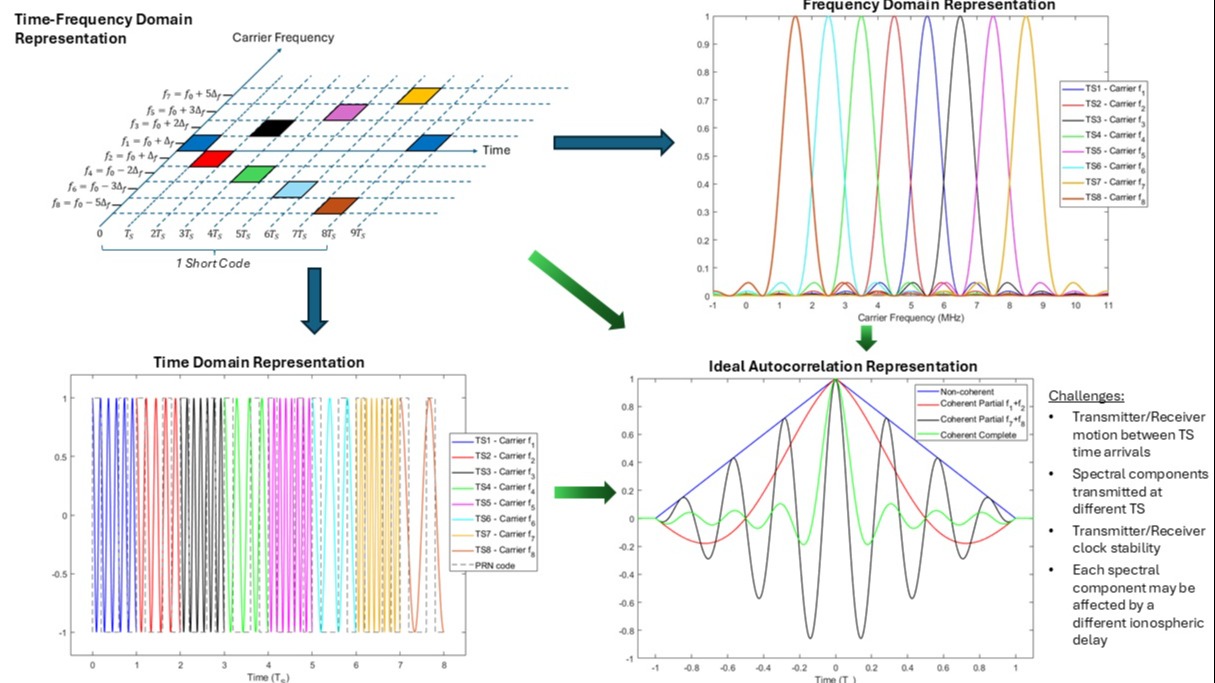
Short-Code Frequency-Hopping (SC-FH) signal concept is an innovative signal design developed by ESA on its LEO PNT system. The signal is divided in time-segments (TS) modulated by a different carrier frequency (sub-band). The carrier frequency of each TS is defined by a Frequency Hopping (FH) process, and the FH sequence (determining each carrier) is fixed and short (Short Code – SC). Each TS carries a typical structure of a navigation signal. The SC is designed to allow the combination in time of different TS around different carrier frequencies; combinations can be coherent, non-coherent, partial (not using all the TS inside a SC) and/or complete.
The main motivation of the SC-FH concept is first, to provide flexibility on the receiver signal processing (suiting the needs of different users, high-end or mass-market), and second, to be more robust against jamming and more compatible with other signals.
The proposed idea consists of exploring innovative synchronization algorithms (time delay, carrier frequency and phase estimation) from the optimal exploitation of the SC-FH signal structure; associated performance will be derived.
To achieve the objective, first the SC-FH signal physical constraints are analyzed to derive basic algorithms and identify the challenges and opportunities: coherent accumulation of TS is limited by hardware imperfections, signal inherent structure (frequency components transmitted at different instants of time but processed simultaneously) or different impact of the ionospheric delay to each sub-band. Finally, advanced algorithms are proposed by exploiting for example the last constraint: ionospheric time delay could be estimated coherently at signal processing level using all signal sub-bands rather than being conducted at measurement level with ionosphere-free combination (non-coherent) using only 2 sub-bands. Multiple-loops or Kalman filter tracking will be proposed to conduct a join estimation of all the synchronization parameters.